|
The
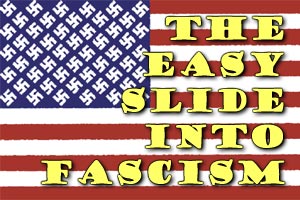
Easy Slide Into Fascism
June
11, 2003
By Bernard Weiner, The
Crisis Papers
 If
my email is any indication, a goodly number of folks wonder
if they're living in America in 2003 or Germany in 1933. If
my email is any indication, a goodly number of folks wonder
if they're living in America in 2003 or Germany in 1933.
All this emphasis on nationalism, the militarization
of society, identifying The Leader as the nation, a constant
state of fear and anxiety heightened by the authorities, repressive
laws that shred constitutional guarantees of due process,
wars of aggression launched on weaker nations, the desire
to assume global hegemony, the merging of corporate and governmental
interests, vast mass-media propaganda campaigns, a populace
that tends to believe the slogans and lies it's fed without
asking too many questions, a timid opposition that barely
contests the administration's reckless adventurism abroad
and police-state policies at home, etc. etc.
The parallels are not exact, of course; America in 2003
and Germany seventy years earlier are not the same, and Bush
certainly is not Adolf Hitler. But there are enough disquieting
similarities in the two periods at least to see what we can
learn - cautionary tales, as it were - and then figure out
what to do with our knowledge.
The veneer of civilization is thin. We know this from our
own observations, and various writers - from Shakespeare to
Sinclair Lewis (It Can't Happen Here) - have shown
us how easily populations can be manipulated by leaders skillfully
playing on patriotic emotion or racial or nationalist feelings.
Whole peoples, like individuals, can become irrational on
occasion - sometimes for a brief moment, sometimes for years,
sometimes for decades. Ambition, hatred, fear can get the
better of them, and gross lies told by their leaders can deceive
their otherwise rational minds. It has happened, it happens,
it will continue to happen.
One of the most outrageous and horrific examples of an entire
country falling into national madness probably was Hitler's
Germany from 1933-45. The resulting world war was disastrous,
leading to more than 40,000,000 deaths.
A good share of what we know about how this happened in
Germany usually comes to us many years later from post-facto
books, looking backward to the horror. There are very few
examples of accounts written from the inside at the very time
the events were unfolding.
One such book is Defying Hitler, by the noted German
journalist/author Sebastian Haffner. The manuscript was found,
stuffed away in a drawer, by Haffner's son in 1999 after his
father's death at age 91. Published in 2000, the book became
an immediate best-seller in Germany and was published last
year in English, translated by the son, Oliver Pretzel. (His
father's original name was Raimund Pretzel; as Sebastian Haffner,
he went on to a highly successful career, writing in England
during the war and then later back in Germany. He authored
From Bismarck to Hitler and The Meaning of Hitler,
among many other works.)
Defying Hitler is a brilliantly written social document,
begun (and ended abruptly) in 1939; even though it fills in
the reader on German history from the First World War on,
its major focus is on the year 1933, when, as Hitler assumed
power, Haffner was a 25-year-old law student, in-training
to join the German courts as a junior administrator.
You find yourself reading this book in amazement; there
is so much historical perspective, so much sweep of what was
going on and predictions of what later was to happen, so many
insights into what led so many ordinary Germans to join with
or acquiesce to the Nazi program - how could anyone so young
be so prescient in the midst of the brutal sordidness that
was Nazism? (Indeed, some critics claimed that Haffner must
have rewritten the book decades later; every page of the original
manuscript was sent to laboratories, which authenticated that
it indeed had been composed in 1939.)
The Individual In Society
What distinguishes Defying Hitler, in addition to
its superb writing, is that Haffner focuses on "little people"
like himself, rather than on the machinations of leaders.
He wants to explore how ordinary Germans, especially non-Nazi
and anti-Nazi Germans, permitted themselves to be swallowed
whole into the Hitlerian maw.
Haffner makes occasional broad pronouncements about German
character traits ("As Bismarck once remarked in a famous speech,
moral courage is, in any case, a rare virtue in Germany, but
it deserts a German completely the moment he puts on a uniform"),
but he devotes a good deal of his attention to the question
of personal responsibility. If you read ordinary history books,
he says, "you get the impression that no more than a few dozen
people are involved, who happen to be 'at the helm of the
ship of state' and whose deeds and decisions form what is
called history.
"According to this view, the history of the
present decade [the 1930s] is a kind of chess game among Hitler,
Mussolini, Chiang Kai-Shek, Roosevelt, Chamberlain, Daladier,
and a number of other men whose names are on everybody's lips.
We anonymous others seem at best to be the objects of history,
pawns in the chess game, who may be pushed forward or left
standing, sacrificed or captured, but whose lives, for what
they are worth, take place in a totally different world, unrelated
to what is happening on the chessboard.
"...It may seem a paradox, but it is nonetheless
the simple truth, to say that on the contrary, the decisive
historical events take place among us, the anonymous masses.
The most powerful dictators, ministers, and generals are powerless
against the simultaneous mass decisions taken individually
and almost unconsciously by the population at large...Decisions
that influence the course of history arise out of the individual
experiences of thousands or millions of individuals."
The Riddle Of Hitler's Rise
Haffner tries to solve the riddle of the easy acceptance
of fascism in Hitler's Third Reich. In March of 1933, a majority
of German citizens did not vote for Hitler. "What happened
to that majority? Did they die? Did they disappear from the
face of the earth? Did they become Nazis at this late stage?
How was it possible that there was not the slightest visible
reaction from them" as Hitler, installed by the authorities
as Chancellor, began slowly and then more quickly consolidating
power and moving Germany from a democratic state to a totalitarian
one?
All along the way, Hitler would propose or actually promulgate
regulations that sliced away at German citizens' freedoms
- usually aimed at small, vulnerable sectors of society (labor
unionists, communists, Jews, mental defectives, et al.) -
and few said or did anything to indicate serious displeasure.
In the early days, on those rare occasions when there was
concerted negative reaction, Hitler would back off a bit.
And so the Nazis grew bolder and more voracious as they continued
slicing away at civil society. Many Germans (including some
of Hitler's original corporate backers) were convinced Nazism
would collapse as it became more and more extreme; others
chose denial. It was easier to look the other way.
Haffner saw what was starting to happen, but retreated into
his law studies. Even while the Brownshirts were beating and
killing people in the streets, the courts with which he worked
remained a solid bulwark in defense of traditional democratic
principles. And then one day, the Nazis simply marched into
the Berlin court buildings and took over Germany's judicial
system. Haffner was shaken to the core, but continued studying
for his final exams.
Shortly thereafter, he and his fellow students were dispatched
to a kind of boot camp for ideological and military training.
Haffner, a Christian anti-Nazi, found himself, to his astonishment
and horror, wearing jackboots, a swastika and learning how
to kill.
In an inner monologue, Haffner says:
"There are some things I must never do: never
say anything that I would be ashamed of later. Shooting at
targets is all right. But not at people. I must not commit
myself, or sell my soul...Oh dear! It dawned on me that I
had already relinquished and lost everything. I wore a uniform
with a swastika armband. I stood to attention and cleaned
my rifle....But that did not count: it was not me that did
it; it was a game and I was acting a part.
"Only what if, dear God, there was some court
that did not recognize this defense, but simply wrote down
everything as it happened; that did not look into my heart,
but simply noted the swastika armband? Before that court I
was in a wretched position. Dear God, where had I gone wrong?
What should I say to the judge who asked, 'You wear a swastika
armband and say that you do not want to. Then why do you wear
it?'"
Nazi propaganda, policies and terror had broken down traditional
support-networks. You couldn't be sure whom to trust. Everyone
could be on the government payroll, or could turn into informants
to save their skins. And so arms went out in Nazi salutes,
militarist songs were sung at rallies and on the streets,
"each one of us the Gestapo of the others." In fear, individualism
was crushed, leaving most citizens to relate only to The Leader,
or to their military units, the comradeship offered by fascism.
Millions Of Marks For A Loaf Of Bread
Then there was the economic factor, the terror associated
with having no money with which to live. One reads Haffner's
description of the hyper-inflation crisis, but it's difficult
to accept or understand:
"No other nation has experienced anything comparable
to the events of 1923 in Germany. All nations went through
the Great War, and most of them have also experienced revolutions,
social crises, strikes, redistributions of wealth, and currency
devaluation. None but Germany has undergone the fantastic,
grotesque extreme of all of these together; none has experienced
the gigantic, carnival dance of death, the unending, bloody
Saturnalia, in which not only money but all standards lost
their value.
"...Anyone who had savings in a bank or bonds
saw their value disappear overnight. Soon it did not matter
whether it was a penny put away for a rainy day or a vast
fortune. Everything was obliterated...A pound of potatoes
which yesterday had cost fifty thousand marks now cost a hundred
thousand. The salary of sixty-five thousand marks brought
home the previous Friday was no longer sufficient to buy a
packet of cigarettes on Tuesday...In August, the dollar reached
a million [marks]....In September, a million marks no longer
had any practical value...At the end of October, it was a
billion...The atmosphere became revolutionary once again."
When citizens face uncertainty on this scale - and the fear
and dislocation that attend all such social traumas - a man
on a white horse promising to restore order has great appeal,
even to some staunch democrats.
There were other ingredients that went into the bubbling
fascist vat: the humiliating terms of the Versailles Treaty
that were placed on defeated Germany after World War I; the
unceasing propaganda barrage in the mass media, helping citizens
to agree with the government; the martial mentality that pervaded
society:
"From 1914 to 1918 a generation of German schoolboys
daily experienced war as a great, thrilling, enthralling game
between nations, which provided far more excitement and emotional
satisfaction than anything peace could offer; and that is
where [Nazism] draws its allure from: its simplicity, its
appeal to the imagination, and its zest for action; but also
its intolerance and its cruelty toward internal opponents...Ultimately,
that is also the source of Nazism's belligerant attitude toward
neighboring states. Other countries are not regarded as neighbors,
but must be opponents, whether they like it or not."
And then there is the inexplicable mystique that surrounds
such men as Hitler, that mesmerizes and lures millions into
their web:
"If my experience of Germany has taught me
anything, it is this: Rathenau [who led a progressive government
in 1921-22, and was then assassinated by anti-Semitic thugs]
and Hitler are the two men who excited the imagination of
the German masses to the utmost; the one by his ineffable
culture, the other by his ineffable vileness. Both, and this
is decisive, came from inaccessible regions, from sort of
'beyond.' the one from a sphere of sublime spirituality where
the cultures of three millenia and two continents hold a symposium;
the other from a jungle far below the depths plumbed by the
basest penny dreadfuls, from an underworld where demons rise
from a brewed-up stench of petty-bourgeois back rooms, doss-houses,
barrack latrines, and the hangman's yard. From their respective
'beyonds,' they both drew a spellbinding power, quite irrespective
of their politics."
When Hitler's in-your-face brand of "beyond" power - with
its meanness and arrogance and menace, throwing opponents
in jail, beating them, even killing them - met the traditional
democratic culture, those on the other end often had no tools
at their disposal to combat the new hardball politics:
"It was then that the real mystery of the Hitler
phenomenon began to show itself: the strange befuddlement
and numbness of his opponents, who could not cope with his
behavior and found themselves transfixed by the gaze of the
basilisk, unable to see that it was hell personified that
challenged them."
The Big Lie Technique
And how did Haffner deal for so long with this menacing
force in front of him?
"What saved me was...my nose. I have a fairly
well developed figurative sense of smell, or to put it differently,
a sense of the worth (or worthlessness!) of human, moral,
political views and attitudes. Most Germans unfortunately
lack this sense almost completely. The cleverest of them are
capable of discussing themselves stupid with their abstractions
and deductions, when just using their noses would tell them
that something stinks."
Given their built-in weakness and their willingness to swallow
the most outrageous Big Lies emanating from the propaganda
ministry and the media, most Germans were fruit waiting to
be plucked by the Nazi harvesters.
"They still fall for anything. After all that,
I do not see that one can blame the majority of Germans who,
in 1933, believed that the Reichstag fire was the work of
the Communists. [The Parliament burned down and a convenient
Communist arsonist was fingered, which the Nazis used as the
excuse to unleash police-state tactics against all opponents.]
What one can blame them for, and what shows their terrible
collective weakness of character clearly for the first time
during the Nazi period, is that this settled the matter. With
sheepish submissiveness the German people accepted that, as
a result of the fire, each one of them lost what little personal
freedom and dignity was guaranteed by the constitution; as
though it followed as a necessary consequence."
In short, what should have been a strong political and moral
opposition movement to Hitlerian policies, meekly acceded
to the destruction of their country's institutions of law
and social harmony. The result in society was a clear leaning
toward the dynamic, muscular policies advocated by the Nazis,
and a seething "anger and disgust with the cowardly treachery
of their own [opposition] leadership."
Of course, fear of police-state action always was operative:
"Join the thugs to avoid being beaten up. Less
clear was a kind of exhilaration, the intoxication of unity,
the magnetism of the masses. Many also felt a need for revenge
against those who had abandoned them. Then there was a peculiarly
German line of thought: 'All the predictions of the opponents
of the Nazis have not come true. They said the Nazis could
not win. Now they have won. Therefore the opponents were wrong.
So the Nazis must be right.' There was also (particularly
among intellectuals) the belief that they could change the
face of the Nazi Party by becoming a member, even now shift
its direction."
All of this follows the normal range of psychology, Haffner
says.
"The only thing that is missing is what in
animals is called 'breeding.' This is a solid inner kernel
that cannot be shaken by external pressures and forces, something
noble and steely, a reserve of pride, principle, and dignity
to be drawn on in the hour of trial. It is missing in the
Germans. As a nation they are soft, unreliable, and without
backbone. That was shown in March 1933. At the moment of truth,
when other nations rise spontaneously to the occasion, the
Germans collectively and limply collapsed. They yielded and
capitulated, and suffered a nervous breakdown. The result
of this millionfold nervous breakdown is the unified nation,
ready for anything, that is today the nightmare of the rest
of the world."
Haffner laments that the crimes of the Hitler administration,
given this collective nervous breakdown, have very little
impact on the population, which seems to accept everything
done in its name with a shrug of the shoulders.
"It is one of the uncanny aspects of events
in Germany that the deeds have no doers, the suffering has
no martyrs. Everything takes place under a kind of anesthesia.
Objectively dreadful deeds produce a thin, puny emotional
response. Murders are committed like schoolboy pranks. Humiliation
and moral decay are accepted like minor incidents. Even death
under torture only produces the response 'Bad luck'."
The Slide Toward Fascism
And so it becomes easier to simply permit oneself to sink,
ever so slowly into this collective illness, into accomodation
with the ruling party, even though the police-state is constantly
violating citizens' privacy.
"We were pursued into the farthest corners
of our private lives; in all areas of life there was rout,
panic, and flight. No one could tell where it would end. At
the same time we were called upon, not to surrender, but to
renege. Just a little pact with the devil - and you were no
longer one of the captured quarry. Instead you were one of
the victorious hunters."
Certainly, Haffner and others like him felt their own slide
toward complicity with the Nazis, as their sense of self faded.
"Things were quite deliberately arranged so
that the individual had no room to maneuver. What one represented,
what one's opinions were in 'private' and 'actually,' were
of no concern and set aside, put on ice, as it were. On the
other hand, in moments when one had the leisure to think of
one's individuality...one had the feeling that what was actually
happening, in which one participated mechanically, had no
real existence or validity. It was only in these hours that
one could attempt to call oneself morally to account and prepare
a last position of defense for one's inner self."
Haffner was approaching decision time about his future if
he stayed in the Third Reich. But it's clear which way he
was leaning, as his analyses got darker and darker.
"It is said that the Germans are subjugated.
That is only half true. They are also something else, something
worse, for which there is no word: they are 'comraded,' a
dreadfully dangerous condition. They are under a spell. They
live a drugged life in a dream world. They are terribly happy,
but terribly demeaned; so self-satisifed, but so boundlessly
loathsome; so proud and yet so despicable and inhuman. They
think they are scaling high mountains, when in reality they
are crawling through a swamp. As long as the spell lasts,
there is almost no antidote."
He hung in until 1938. Just prior to the Second World War,
Haffner left Germany for England to join the war-effort against
fascism. He did not return until the mid-'50s.
So, dear reader, examine the above descriptive passages
from the Germany of the 1930s, when the Nazis were assuming
full power, and see what lessons can be learned for our situation
today.
As I write this, Ashcroft is telling the Congress that
the Patriot Act - the same act that more than 100 cities have
voted not to honor because of its numerous violations of rights
guaranteed by the Constitution - does not give the Bush Administration
enough police power and needs to be expanded. (This at a time
when American citizens have been arrested, not charged and
then stashed away on military bases, cut off from judicial
protections; and hundreds of foreign prisoners are being held
by the U.S. military at Guantanamo in violation of both the
U.S. Constitution and the Geneva conventions.)
Demonstrable government falsehoods are being published
by a compliant media, while that same media, owned by corporate
giants, refuses to report factual information that is embarrassing
to the Administration. And finally, the Pentagon is working
on "contingency plans" for the next unilateral invasion of
a sovereign state by the U.S. military.
Bernard Weiner, Ph.D., has taught American government and
international relations at various universities. Formerly
a writer/editor with the San Francisco Chronicle for nearly
20 years, he now co-edits The Crisis Papers (www.crisispapers.org).
|